Here are the #1 songs, according to Billboard magazine, during this week in each of the four years we were undergrads at BC.
1965 -- (I Can't Get No) Satisfaction, Rolling Stones
1966 -- Paperback Writer, Beatles
1967 -- Windy, Association
1968 -- This Guy's In Love with You, Herb Alpert
The website #1 Song on this Date in History can give this information for the entire 20th and 21st centuries and also offers links to the individual songs on iTunes or other music sites.
Wednesday, July 2, 2008


Wednesday, May 28, 2008
For here men are men ....
 The topic of women at BC 1964-68 probably deserves an entire blog itself. So this post touches on only a few elements.
One image of women students here is conveyed by the photo at right. The Heights, as enlightened as it perceived itself to be, regularly ran photos of, dare I say, pretty girls who were BC students. Sub Turri, for a number of years, had a "queen," and one could vote numerous times each year for the "queen" of this or that dance or event, e.g., Homecoming.
This is not to say BC was so different from many other colleges at the time. Even public institutions and women's colleges in the day had policies and regulations probably intended more to "protect" women than empower them.
Looking back, however, brings you to some things that today seem humorous, bizarre, or both.
In October 1965, Bobbi McKuskie, ’69, became the “first girl to march with the BC band,” as she debuted at halftime of the BC-Penn State football game ... to twirl the baton. In March 1968, the Heights reported that approval had been received to add three "lithe, lovely majorettes" to the band.
As associate editor of the Heights in 1967, Mimi Hirsh was the only female editor. Three of the 22 members of the news staff were female, but all three of the "typists."
A "restaurant guide" in The Eagle's (sic) Handbook for resident men offered this advice: "The economy-minded B.C. man with a hungry date will appreciate the Beacon Hill Kitchen, 23 Joy St., or The English Room, 29 Newbury St."
The Resident Women's Handbook for 1966-67 includes the following regulations and statements:
"Each student must make her bed each day before leaving the residence...."
"The law requires that all dormitory shades be drawn as soon as the lights are put on."
"A student may not sleep in any bed other than her own unless permission is given by her housemother, and more than one student may not sleep in a bed at any one time." (!)
"If the student is more than an hour late and has not called her housemother, the latter will call the student's parents, collect, to inform them of her absence."
"When her residence is open, no student will be permitted to stay overnight in any hotel, motel, inn, guest house, or apartment within 25 miles of Boston unless she is with her parents or an approved chaperone."
"Shorts and slacks are worn outside the residence only when they are appropriate attire for the student's activities--as for picnics, the beach, etc.; and when leaving the residence in shorts or slacks, the student is expected to wear a knee-length coat."
Male students had some interesting rules and regulations as well, but nothing really as onerous as some of those applied to women. The women's residences on South Street were apartment buildings, which BC even described as "not designed to serve as dormitories." For several years, women complained of lack of privacy, no place to entertain guests, inadequate bathroom facilities, poor food, cold rooms, no recreation facilities, no televisions and no permission to bring one, and no options. The Heights in 1965 said, "It is surprising that BC, with all its beautiful new buildings on campus, can afford to let prospective students even see the women's dorms."
In November 1967, there was a Sunday afternoon open house at each of the eight women's dorms – Kirkwood, Linden, Pine, Radnor, Chestnut, South, Greycliffe, Alison. The event, the Heights reported, would "enable BC coeds to entertain guests in their rooms for the first time this year and to show visitors living conditions which many women believe are almost intolerable.”
And then there was the fact that no women could enroll in A&S or CBA. A petition to permit women in A&S, signed by 1,500 members of the campus community, was presented to the administration in March 1967. Three years and a few months later, women enrolled in any and all of BC's schools.
I had not been aware of this fact previously, but the female Bald Eagle is larger than the male. Today, the majority of students -- both undergraduate and graduate and in all schools but the Carroll School of Management and Woods College (formerly the Evening School) -- are women. And, while late starters compared to male students at BC, women now represent the majority of BC alumni.
Tuesday, May 27, 2008
The food 'riot'
We'll talk in another post soon about the impact of national politics on campus, but there were a series of events in 1965 and 1966 that struck at a fundamental element of the well-being of male resident students -- food. And it was an interesting early exercise in "student power."
On December 12, 1965, Sunday dinner at McElroy was the often volatile, as I recall, roast beef au jus. In the wee hours of the following morning, the bathrooms in the dorms were crowded with young men suffering from what the Heights referred to in its coverage as "intestinal disorders." Not a pretty sight. The Heights' headline on Dec. 17, 1965, was “Drury Commission to Study Christmas Dinner Sickness.”
In March, the following spring, after little if any improvement and perhaps to bolster confidence in the quality of the BC-run food operation at McElroy, the administration reported on an inspection by the Newton Board of Health. The board's report called the McElroy Commons kitchen ‘one of the finest kitchens in Newton.’” (A high standard, indeed.) As a possible clue to the "Christmas dinner sickness" and a portent of things to come, however, one board member suggested refrigeration in the meat preparation room would be a good idea.
Only two days following the board of health's report, and faced with a Sunday "dinner" consisting of a "sub" containing a breaded veal cutlet and tomato sauce, the male resident students expressed their own opinion. As the subsequent Heights article reported, "The riot, begun by a lone, soaring milk carton, immediately turned into a tray-throwing melee which, while no more than one minute long, left McElroy dining hall littered with un-eaten food and over-turned chairs.”
An ad hoc committee of students, including classmate Peter Driscoll, quickly established a series of orderly demonstrations to further the cause of better food. Again relying on Heights coverage for the details, a large number of students showed up for dinner at 5:55 pm, just before 6 pm closing, the day after the riot. The cafeteria had to remain open until 6:20 to accommodate. The following night, in an escalation, students formed a single line of approximately 600 students, disdaining the two other distribution lines available, near closing time, and that required the cafeteria to remain open until 7:20 pm. Wednesday night, students marched peacefully in the rain from Cheverus to St. Mary’s Hall and demanded better dining conditions.
By the end of April, a company called Saga was running the McElroy operation, with short-term improvements, at least. One perhaps unexpected result of the upgrade was that, according to the April 29, 1966 Heights, “The students are, at times, perplexed with the plethora of selections.”
Anybody have favorite memories of McElroy food back in freshman-sophomore years?
On December 12, 1965, Sunday dinner at McElroy was the often volatile, as I recall, roast beef au jus. In the wee hours of the following morning, the bathrooms in the dorms were crowded with young men suffering from what the Heights referred to in its coverage as "intestinal disorders." Not a pretty sight. The Heights' headline on Dec. 17, 1965, was “Drury Commission to Study Christmas Dinner Sickness.”
In March, the following spring, after little if any improvement and perhaps to bolster confidence in the quality of the BC-run food operation at McElroy, the administration reported on an inspection by the Newton Board of Health. The board's report called the McElroy Commons kitchen ‘one of the finest kitchens in Newton.’” (A high standard, indeed.) As a possible clue to the "Christmas dinner sickness" and a portent of things to come, however, one board member suggested refrigeration in the meat preparation room would be a good idea.
Only two days following the board of health's report, and faced with a Sunday "dinner" consisting of a "sub" containing a breaded veal cutlet and tomato sauce, the male resident students expressed their own opinion. As the subsequent Heights article reported, "The riot, begun by a lone, soaring milk carton, immediately turned into a tray-throwing melee which, while no more than one minute long, left McElroy dining hall littered with un-eaten food and over-turned chairs.”
An ad hoc committee of students, including classmate Peter Driscoll, quickly established a series of orderly demonstrations to further the cause of better food. Again relying on Heights coverage for the details, a large number of students showed up for dinner at 5:55 pm, just before 6 pm closing, the day after the riot. The cafeteria had to remain open until 6:20 to accommodate. The following night, in an escalation, students formed a single line of approximately 600 students, disdaining the two other distribution lines available, near closing time, and that required the cafeteria to remain open until 7:20 pm. Wednesday night, students marched peacefully in the rain from Cheverus to St. Mary’s Hall and demanded better dining conditions.
By the end of April, a company called Saga was running the McElroy operation, with short-term improvements, at least. One perhaps unexpected result of the upgrade was that, according to the April 29, 1966 Heights, “The students are, at times, perplexed with the plethora of selections.”
Anybody have favorite memories of McElroy food back in freshman-sophomore years?
Thursday, May 22, 2008
My Eagle has been psychedelicized!
 It might have been the summer of love in San Francisco in 1967, but in the spring of that year in Chestnut Hill, it was Gentle Monday. The Heights photo above shows George Drury, SJ, vice president (and looking cool in his shades), joining Janice Kolar, I believe, and "Naked Ned" for the festivities May 1, 1967.
You can see a few more photos from that auspicious event by clicking on the image below. Groovy, man.
 |
| Gentle Monday |
Tuesday, May 20, 2008
Feel a draft?
 There was likely no bigger elephant in the room for most of the male members of the class during 1967 and 1968 than the draft. There were classmates who knew they would be going into the service (certainly members of ROTC), those who worked assiduously to avoid it, and, the largest group, those who tried to make the best out of uncertainty.
The Selective Service and Congress didn't do much to help, as they came up with new and different ways to determine those who would be selected and inducted. College enrollment itself provided a deferment from the draft, a circumstance that increasingly became seen as unfair to young men not in college. Steps were taken to be "fairer." I recall going home to my hometownto take a test, which, depending on your score, was to determine your draft status. My score was high enough to gain deferment, but then that process was ruled unfair before going into effect.
Graduate school had been sufficient for a deferment, but then, as the Nov. 13, 1967, Heights headline said, "Grad school acceptance no protection from draft." Options became fewer and more senior males began receiving notices of 1-A status ("available for military service") and calls to take pre-induction physicals.
Along with several of my friends, in the winter of 1967-68, I applied for Navy Officer Candidate School. That also required a test. I applied to graduate school as well, and may have learned around the same time in spring 1968 that I was accepted at both. Yippee! ... At least, I felt, it looked as if my near future would be along one of those roads. And it quickly became clear, under the circumstances, that the Navy was the more realistic option.
Most of my close male friends, at graduation, did not know what they would be doing. I did know and, as I likely would not have chosen to serve in the military under different circumstances, the comfort I felt in it was somewhat odd. My first day of active duty in the Navy was the same day BC defeated Navy in football, which I latched on to as a good omen. I served as a Naval officer for the next three years, including a tour in the Gulf of Tonkin. At OCS, a classmate, Greg McClure, was in my company and a classmate, Steve Curran, was also one of my shipmates on the USS Biddle (DLG-34). I didn't know Steve at BC, but we've kept in touch since the Biddle and we both attended an all-hands ship's reunion in 2006.
Most of my friends, at least, served briefly in the reserves, Peace Corps, or VISTA, and began grad school and the rest of their lives a little ahead of me. I finally did get to grad school and, indeed, later served enough years in the Navy Reserve to retire as a Commander. But that's another story ....
Do you remember the draft as a dominant spectre during senior year, for yourself or, if you're a woman, for male classmates you knew?
According to a list of Vietnam veterans being compiled by Boston College Magazine, 45 members of the class served in Vietnam, including six who were killed in action. We should pause to remember and honor classmates Steven Donaldson, Louis Favuzza, Frederick Harrington, Robert Hauer, Christopher Markey, and Michael Monahan, who died in service to their country. We will miss their presence, and that of other classmates who have died, at our reunion.
Sunday, May 18, 2008
Boston 1968 on screen
 This weekend, a local PBS station broadcast The Thomas Crown Affair, a movie set in Boston in 1968. I'd seen it before, of course, but this time, considering the amount of reminiscing lately, I watched it with particular interest.
Steve McQueen, the epitome of cool in that era to me, was the star, along with Faye Dunaway. As a movie, it was not great, but it was the Boston of 1968 that was great to see. You'd have to watch it several times to catch all the scenes, but they include Beacon Hill, the Mass Pike, the Cape, Myopia Hunt Club ... actually I didn't really hang out at Myopia much.
The movie is also a "screen capture" :-) of the fashion of the era, in clothes, cars, interior design, etc. There have been a flurry of movies set in Boston recently -- The Departed, Gone Baby Gone among them -- but The Thomas Crown Affair is fun to see. Here's some more info about it.
Any other movies you recall set in Boston in the 1960s?
Thursday, May 15, 2008
Well, I Finally Signed Up
I wasn't certain about attending a 40th reunion. The 25th reunion had been a lot of fun; but that was 30 lbs and a lot of hair ago.
Should I go? It will probably be the last time we'll be getting together....
I was still on the fence, when John Klish called me and said he was going to be there, along with Pradeep and Jake and George. That sounded good; but, was it too late? Happily the time for housing registration was extended and event registration is still open. The Newton Marriott was pretty well booked up; but I found an alternative in Framingham and I'm good to go.
Signing up online for "The Way We Were-1968" and the "40th Class Party" was easy, along with the class gift, which can be designated for your choice. I enjoyed my time at BCLS, so I hope every little bit helps.
Dean and centenarian
 Rita Kelleher was dean of the School of Nursing at BC from 1948 to 1968. She was among those receiving an honorary degree at our commencement. In March, Dean Kelleher celebrated her 100th birthday. That means that when she received her honorary degree that day she was 60 years old. She was younger then than just about all of us are today. Ho ... lee ... cow.
James Woods, SJ, dean of the Woods College of Advancing Studies (known in our time as the "Evening College"), wrote a very nice article about Dean Kelleher that appears in the current edition of The Voice, the magazine for graduates of the Connell School of Nursing.
Wednesday, May 14, 2008
It's all happening at ...
 Members of the class distinguished themselves by acting somewhat raucously at BC basketball games. Then again, some of the behavior was viewed as "undistinguished." The Heights of Feb. 11, 1966, for example, reported that several campus groups had complained about "profane signs" posted by the '68 fans at the game with St. Joseph's on Feb. 2. Even Coach Cousy was quoted as saying some of the signs were "tasteless" and he expressed some regret that the game had been televised nationally. The Class of '68 "zoo" was an apt and heartfelt self-description.
For some more pictures related to BC sports during our years, click on the image below.
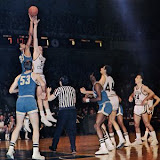 |
| Sports68 |
Tuesday, May 13, 2008

Maybe it was because I worked on the Heights, but I always found the little messages that served as "bookends" for the front page title (the "flag") interesting. I've recreated a few from 1966 and 1967 that may elicit a few memories, smiles, groans, etc. You can see the others by clicking on the image below
 |
| Heights bookends |
Friday, May 9, 2008
Name that cast!

That's Alan Borsari, front, center, and left to right, among some of the cast of the Class of '68 skit at the School of Ed. Can people name the rest of the cast?
The skits were cancelled in the mid-'90s as not befitting the academic stature of the School, which is now the Lynch School of Education. A lot of people still miss them.
You can see pictures of a few other extracurricular activities--the Chorale, Dramatics, Lewis Drill Team, and WVBC--by clicking on image below.
 |
| Extracurri |
Thursday, April 24, 2008
Omygawd, college!
When we arrived at BC in September, 1964, it was a heady time for us -- college! -- and near the beginning of what many people consider a particularly turbulent time in US history. It was less than a year after the assassination of President John Kennedy, who had been speaker at BC's 1963 centennial celebration about 16 months before we arrived (link to text). Essayist Lance Morrow said of that time, “The real 1960s began on the afternoon of November 22, 1963. It came to seem that Kennedy's murder opened some malign trap door in American culture, and the wild bats flapped out.”
Our moods, despite the circumstances of the world around us, were likely not very dark. There was a lot new for us to digest and many new people to meet. Roommates who weren't brothers or sisters, classes instead of "school days," more freedom, etc. Here are some Heights headlines and items from the fall of 1964 that give a flavor of that time.
Our moods, despite the circumstances of the world around us, were likely not very dark. There was a lot new for us to digest and many new people to meet. Roommates who weren't brothers or sisters, classes instead of "school days," more freedom, etc. Here are some Heights headlines and items from the fall of 1964 that give a flavor of that time.
September 25, 1964
Director of Resident Men"
October 1964
October 23, 1964
“McCrossen Flays Commies
Liberals Seen Shuddering”
The Heights editors, as was their wont, had some fun with the headline for the article on the annual Young Americans for Freedom lecture, presented that year by Vincent McCrossen. Prof. McCrossen was an outspoken political conservative, on what was, as we would see displayed in several ways during our time at BC, a pretty conservative campus.
November 6, 1964
“Fr. Drinan Sees
Hard Years Ahead
For Civil Rights”
Got that right.
November 13, 1964
“
No Marriage for Women”
Notice the rule did not apparently apply to men. While nearly everyone would consider this incredibly sexist, based on our current mores, note the context. In the opinion of administrators such as Mary Kinnane in the School of Ed, higher education for women was the objective and marriage was then an impediment to a young woman finishing college. As with so much else at the time and in the culture of the place, negative reinforcement was the method of choice. Remember, too, this was during a time when a pregnant teacher (of course, married) could not teach in a public school while she was "showing."
The topic of women at BC was such a major issue, in so many ways. There will be many other points of discussion on that topic.Good sports from the start

One could argue that the past few years have been the best ever at BC in terms of sports. Multiple winning seasons, NCAA tournament appearances, and national and conference championships in football, basketball, and hockey. (Let alone growth in Olympic sports and the development of women’s sports, which is a completely different topic we’ll address in another context.)
But things certainly weren’t bad in our day, even as freshmen. Remember our first football game as freshmen, when we operated as a card section for the first and, as far as I can remember, only time? BC played
BC then lost its next two games, against Army and
Hockey finished #2 in the country freshman year, losing to Michigan Tech in the NCAA final. They opened with 19 wins in their first 22 games, including a 5-4 win over BU for the Beanpot, and finished 24-7 (no ties!). Funny to note now that the Eagles got to the NCAA final with a 4-3 win over …
Numbers game
As of a couple of months ago, there were 1,412 members of the class that graduated from BC still around. I'm still trying to track down how many there were at graduation. (Another 181 were members of the Newton College class of 1968.)
Of that total, 1,055 were men and 357 women, pretty much a 3-1 ratio.
In terms of school affiliation (rounded)
A&S -- 37 percent
CBA -- 28 percent
School of Ed -- 19 percent
Nursing -- 10 percent
Evening -- 4 percent
Ex (didn't graduate) -- 3 percent
Of that total, 1,055 were men and 357 women, pretty much a 3-1 ratio.
In terms of school affiliation (rounded)
A&S -- 37 percent
CBA -- 28 percent
School of Ed -- 19 percent
Nursing -- 10 percent
Evening -- 4 percent
Ex (didn't graduate) -- 3 percent
Wednesday, April 23, 2008
Curse of living in exciting times?
My 18-year-old daughter has sometimes expressed to me her envy that, when I was about her age, I … and we … lived in such “exciting” times. In a recent edition of the Heights, Amanda Leahy, a freshman in A&S, has a column saying current students are complacent and she urges them to fight for the causes they believe in.
“It is hard to contemplate the fact that 40 years ago,” she writes, “students our own age, students very much like us, collectively helped to shape history. While many students today are indeed passionate about the causes they believe in, gone is the dramatic vigor and the action that characterized college life during the ’60s. Gone are the urgent demands upon universities to change unfair policies, and lost with them are the sit-ins, the protests, the willingness to sacrifice anything for a common cause, the refusal to stop until real and lasting changes were made.”
Not everyone has such a vaulted sense of the impact of students during the ’60s. But it is striking to me, at least, to realize, when viewing various documentaries about the period, how much the times were characterized by violence and protest. Certainly September 11 was and the war in Iraq and Afghanistan is violent, but much of the conflict we experienced and saw on television was American on American -- civil rights protests and angry reactions to them, college protests broken up by police swinging batons, fights between protestors and anti-protestors.
Did it seem kind of “normal” to you at the time? Not meaning that it was a good thing, but that it may have seemed a logical consequence of the issues and pressures in play?
I have a record album entitled “The Incredible Year.” It is a compilation of audio clips of events of 1968, produced by CBS News and narrated by Charles Kuralt. Many clips are very moving to hear again, and I hope to figure out a way to put some of them here (I’ve had it digitized). I plan to play some of them during the panel at reunion weekend, as introductions to sections of the discussion. “Glancing back at 1968 we find it hardly believable that so much drama, tragedy, and triumph could have been crammed into its mere 12 months,” say the album notes. “What made 1968 so incredible was the complete flip-flop of the expected. Event after event failed to follow the prepared script. Shock, horror, delight, and surprise came one upon the other in hammer-blow sequence.”
As mentioned in a post above, we arrived at BC less than a year after the assassination of President Kennedy, so it wasn’t that we were unfamiliar with shock and tragedy. But during our years at BC, things seemed to ratchet up incrementally and sometimes exponentially. I’ll have posts up soon about some of those issues.
Monday, April 21, 2008
A dream deferred?
The nation marked the 40th anniversary of the murder of Martin Luther King, Jr., on April 4. We didn’t know at the time, of course, that his assassination would be but the first of two killings of national figures, and heroes to many, that would mark our last several weeks at BC.
There were several columns in the same issue of the Heights that discussed the issue of race relations in the
We weren’t a diverse campus back then, unless you consider coming from different parishes in
Sunday, April 20, 2008
James Brown to the rescue?
Among the television programs shown in connection with the anniversary of the assassination of MLK was presentation on VH1 of the documentary “The Night James Brown Saved Boston.” Brown had been scheduled to do a concert in the
I remember being among those watching the telecast of the concert at the Tam, more formally the Tam O’Shanter Lounge on
I recommend the documentary to you. It really helps bring back the days.
Subscribe to:
Posts (Atom)